Your Daily Brief
What it is
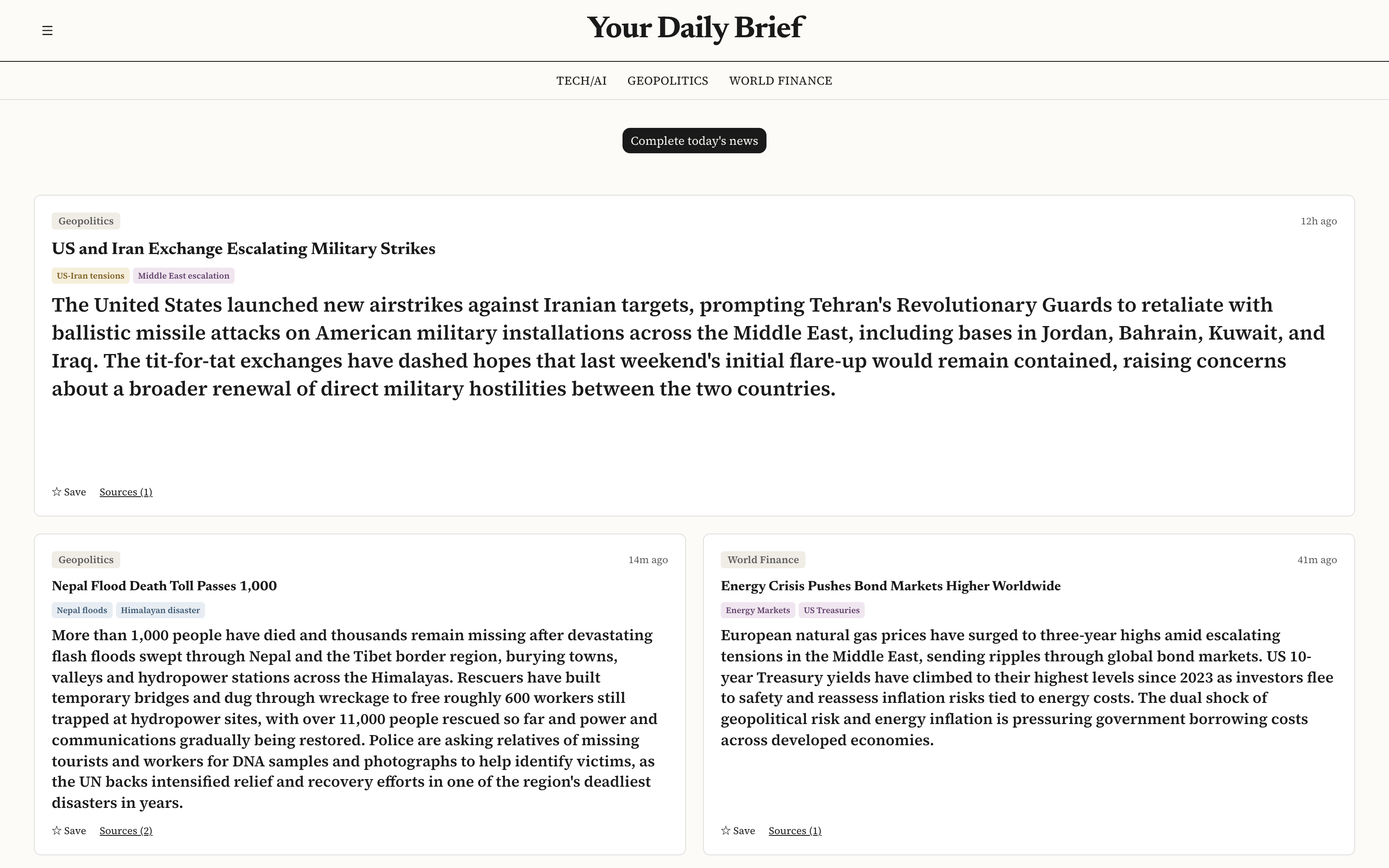
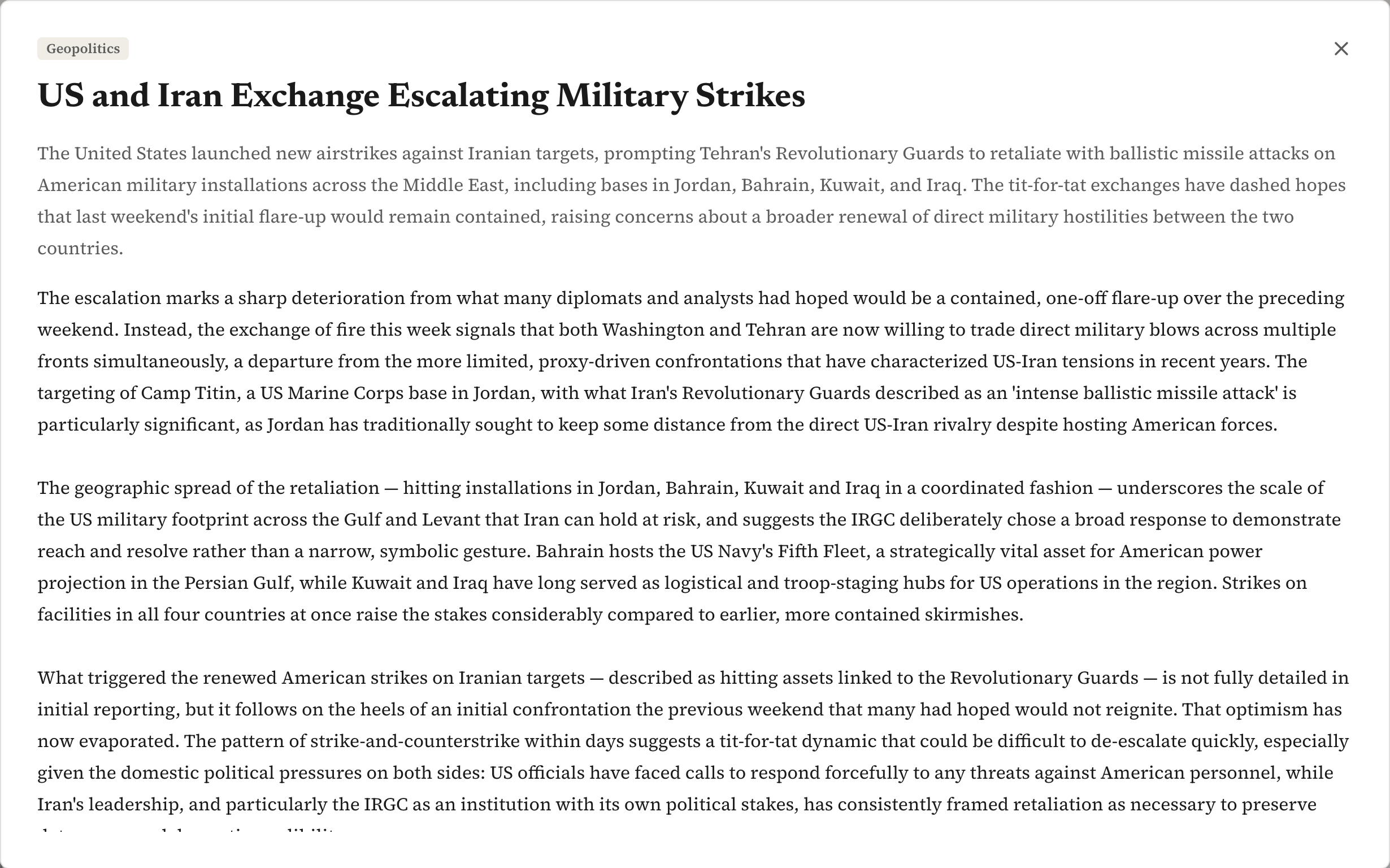
A daily news reader built around one question: what actually happened today in the things I care about? You choose your topics once, and if you like, the outlets you trust most. After that, asking for the day's news returns a feed where every card is a single story — not a headline, not a topic roundup — written from all the outlets that covered it, with a short summary up front and the full report and its sources one click down.
How it's used
Join by invite (you can ask for one in the app) and pick three to ten topics and countries, plus any outlets you want to count for more. Ask for the day's news. Read the feed, expand anything worth more than a summary, bookmark what you want to keep, and walk back through previous days from the history view. That is the whole loop. It is built to be a five-minute morning habit rather than somewhere you lose an hour.
Stack & architecture
RSS ingest → local embedding clustering → Claude Haiku triage → Haiku or Sonnet card writing → Haiku front-page ranking.
Embeddings run locally, so clustering is free. Haiku judges every cluster and writes the cards built from one source, which are most of them; Sonnet writes only the stories several outlets covered.
Next.js on Vercel with Supabase. Every reader's Claude calls run on one server-side key, so a Postgres ledger reserves each digest's worst-case cost before any call and settles it after; a crashed run still counts. Caps: $2.00 per account, $10.00 overall, per 24 hours.
Signup needs a single-use invite, enforced in a Supabase auth hook; sessions can read their digests but not write them. Both were probed against the live app.
What it doesn't do yet
The gaps known today, stated up front.
- It's in early testing, and signup is by invite only.
- Two outlets covering one story sometimes still produce two cards. The clustering is good, not solved.
- Most feeds give only a sentence or two per article, so a card is often written from little more than its sources' headlines.
- Each digest has two minutes to finish. The heaviest profile allowed, ten topics, took about a minute when it was measured live.